McMaster University

Road Revolution: Rethinking Pavement

How can the City of Hamilton design better, cost-effective roads by comparing concrete, asphalt, and composite roads for the City's infrastructure?
Project Description: The City of Hamilton is evaluating the long-term benefits of different pavement cross sections enhance its infrastructure. The challenge is to compare the costs, durability, and sustainability of using concrete, composite, and asphalt pavements across various road projects. The City wants to understand the trade-offs in using each material, especially with soft subgrades, and incorporate modern solutions like geogrid technology to reduce excavation and improve soil stability. Additionally, the City aims to explore how the use of different pavement make ups can impact excess soil and the amount of excavation required to make structurally sound pavements. There is interest in how the Excess Soils Regulations (O.Reg 904/19) and the use of Reclaimed Asphalt Pavement (RAP) can shape future road construction practices. The students work shall include analyzing data on current road conditions, replacement costs, and lifecycle assessments to recommend the best materials for different projects.

City Staff: Mitchell Knott, Public Works Department

Deliverables: Primary and Secondary Research

Project Partner: McMaster University

Location: City Wide

City Strategy Priority: Built Environment and Infrastructure
3-D Prototyping for Community Initiatives

Can 3D printing be used to test viability and engage makers to produce and distribute essential tools for community needs?

Project Description: This hands-on project combines innovation, social impact, and community collaboration by engaging the student community in market research and prototyping innovative accessories and tools for individuals in need. As part of the first phase of the project, students will undertake research on the potential products which could be used for social need to develop from 5 to 10 viable products that can be produced using additive manufacturing. Future project phases will consider methods to partner with community organizations and determine optimal distribution channels to reach the target audience.

City Staff: Alex Consoli, Senior Program Manager, Corporate Services Department

Deliverables: Primary research, Secondary research, feasibility study, prototype/design, workshop/event

Project Partner: McMaster University

Location: City Wide

City Strategy Priority: Community Engagement and Participation, Healthy and Safe Communities, Economic Prosperity and Growth, Culture and Diversity

Active Transport: Shifting Trends

What are the factors that may influence the adoption of active transportation modes?

Project Description: Over the years, the City has implemented numerous bike lanes and multi-use paths with the expectation of shifting trips from private vehicles to active transportation modes. This study will assess the actual versus expected impact on mode share and identify factors that may influence adoption. There are several research questions to be considered including:

  • What extent has the implementation of bike lanes and multi-use paths influence modal shift?

  • How does usage vary based on infrastructure type, land use, connectivity, and demographics?

  • What barriers limit higher adoption rates, e.g., safety concerns, network gaps, lack of end-of-trip facilities?

  • How do factors such as weather, trip distance, and social acceptance impact modal shift?

The information shall be used to help inform the framework for continuous performance monitoring of active transportation investments.

City Staff: Tanvir Chowdhury , Project Manager, Public Works Department

Deliverables: Primary research, Secondary research, feasibility study, policy paper

Project Partner: McMaster University

Location: City Wide

City Strategy Priority: Community Engagement and Participation, Healthy and Safe Communities, Economic Prosperity and Growth, Culture and Diversity, Clean and Green, Built Environment and Infrastructure
Connecting with Rural Communities

How can the City of Hamilton effectively reach rural residents to share news, updates and engagement opportunities?

Project Description: The City of Hamilton is home to urban and rural communities, each with unique communication and engagement needs. The City shares information about programs, services, and initiatives to its urban and rural communities using various communication tactics, including print and digital advertising, social media, and media relations. 

The decline of local news outlets in rural areas creates challenges to share information about municipal issues and decisions, which can lead to the risk of misinformation, reduces civic engagement, and weakens transparency.

The focus of this project is to gather information about what channels do rural residents prefer to hear about City news, service updates and engagement opportunities.

City Staff: Sylvia Pena, Communications and Strategic Initiatives

Deliverables: Primary research, Secondary research

Project Partner: McMaster University

Location: Ward 9, Ward 11, Ward 12, Ward 13, Ward 15

City Strategy Priority: Community Engagement and Participation

Municipal Grant Study

How can we measure the economic and social impact of programs and services funded by the City Enrichment Fund?

Project Description: The City Enrichment Fund (CEF) provides funding annually to support more than 300 nonprofit programs across Hamilton for service areas including Agriculture, Arts, Communities, Culture & Heritage, Community Services, Digital, Environment, and Sport & Active Lifestyles. The focus of this project is to quantify the economic and social impact of the programs supported by the City Enrichment Fund. The project will help develop insights including:

  • The economic impact of City Enrichment Fund program areas;

  • The estimated resource requirements for the municipality to provide these services directly;

  • The number of residents impacted by the programs which are funded through the City Enrichment Fund; 

  • A replicable methodology for assessing the City Enrichment Fund program areas.

Students shall review individual City Enrichment Fund projects as case studies to help create a methodology that shall calculate the replacement cost for future City Enrichment Fund projects.

City Staff: Rebecca Frerotte, City Manager’s Office

Deliverables: Secondary research, Business case

Project Partner: McMaster University

Location: Citywide

City Strategy Priority: Community Engagement and Participation, Economic Prosperity and Growth, Our People and Performance

Evaluating Green Infrastructure in Hamilton

What is the current condition of the City’s Low Impact Development Infrastructure? How effective are they in reducing stormwater runoff?

Project Description: This project challenge will assist the City of Hamilton and the community partner, Green Venture to evaluate the ability of Low Impact Development in Hamilton, particularly rain gardens, green roofs and bioswales, in reducing stormwater runoff in Hamilton. This project will build on the work completed during a CityLAB project undertaken during Winter 2025 and will pilot the ArcGIS and Survey 1-2-3 tools. Low Impact Development projects play an important role in managing stormwater, filtering pollutants, and enhancing the aesthetic and ecological value of urban spaces. There is a growing need to assess their overall impact and measure both quantitative and qualitative metrics to better understand their effectiveness and guide future initiatives.

City Staff: Justin Wilson, Liz Enriquez Public Works Department

Deliverables: Primary research

Project Partner: McMaster University

Location: City Wide

City Strategy Priority: Clean and Green, Built Environment and Infrastructure
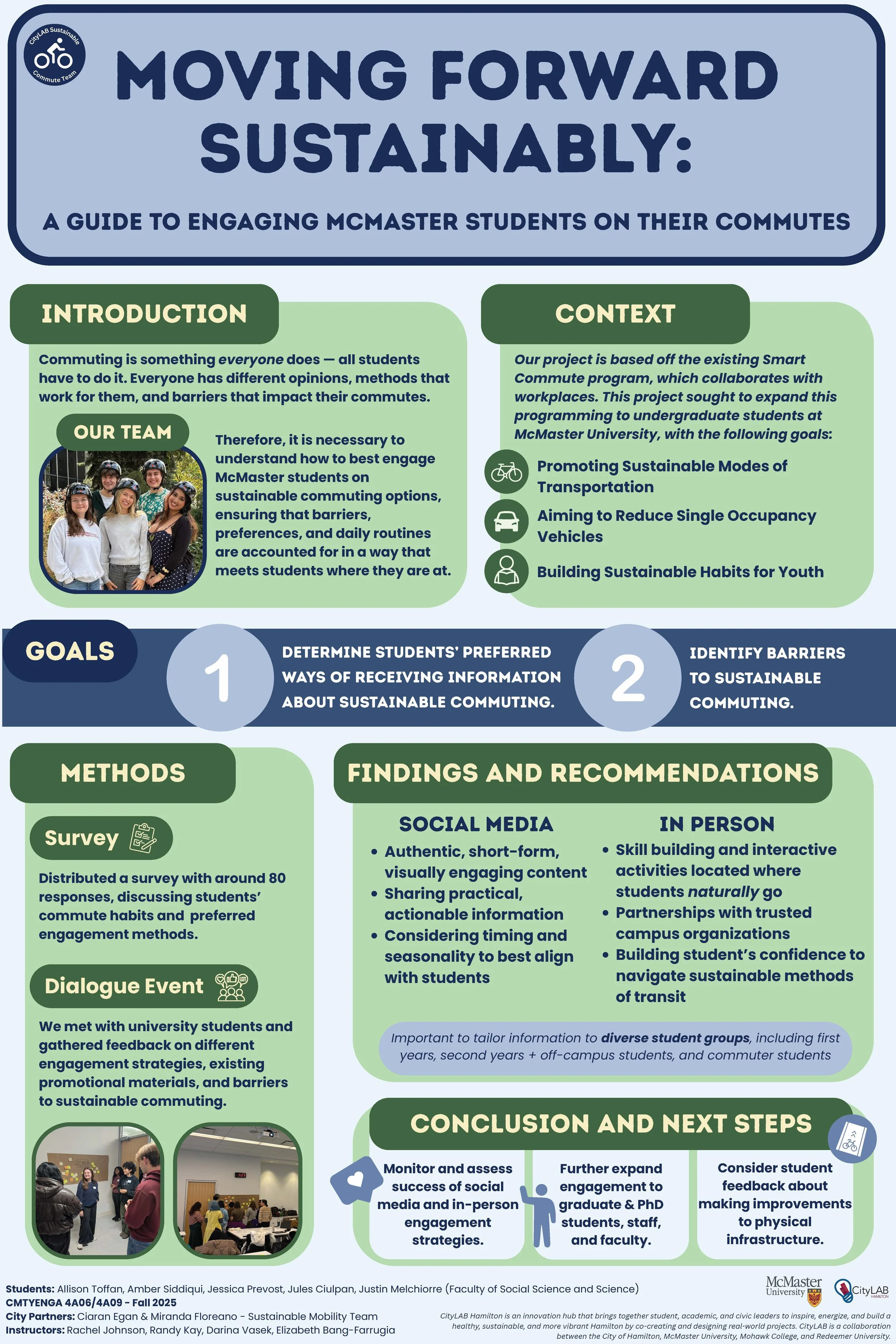
Engaging Students on their Commute

How can the City create an effective outreach strategy for McMaster students to encourage sustainable travel to and from campus?

Project Description: McMaster University is part of the Smart Commute program which encourages employers to promote sustainable transportation for their worksites. Smart Commute would like to expand its engagement and program tactics to help engage McMaster students to use sustainable transportation to campus. A main Smart Commute tool is the Rideshark app which helps people find carpool rides to reach central employment hubs. This project challenge is to determine current carpool usage for students travelling to campus and potential barriers that may prevent this from being a successful engagement. The project shall also engage with students to review ways to encourage public transit or cycling as an option for medium or short commutes and to promote the programs McMaster University currently offers to students such as the transit and bike share passes.

The main deliverable for the project is to create an engagement strategy to promote the Smart Commute program at McMaster with the goal of being able to adapt this strategy in the future for Mohawk College and Redeemer University

City Staff: Miranda Floreano, Planning and Economic Development Department

Deliverables: Secondary research, policy paper, event

Project Partner: McMaster University, Semester in Residence

Location: City Wide

City Strategy Priority: Clean and Green, Healthy and Safe Communities

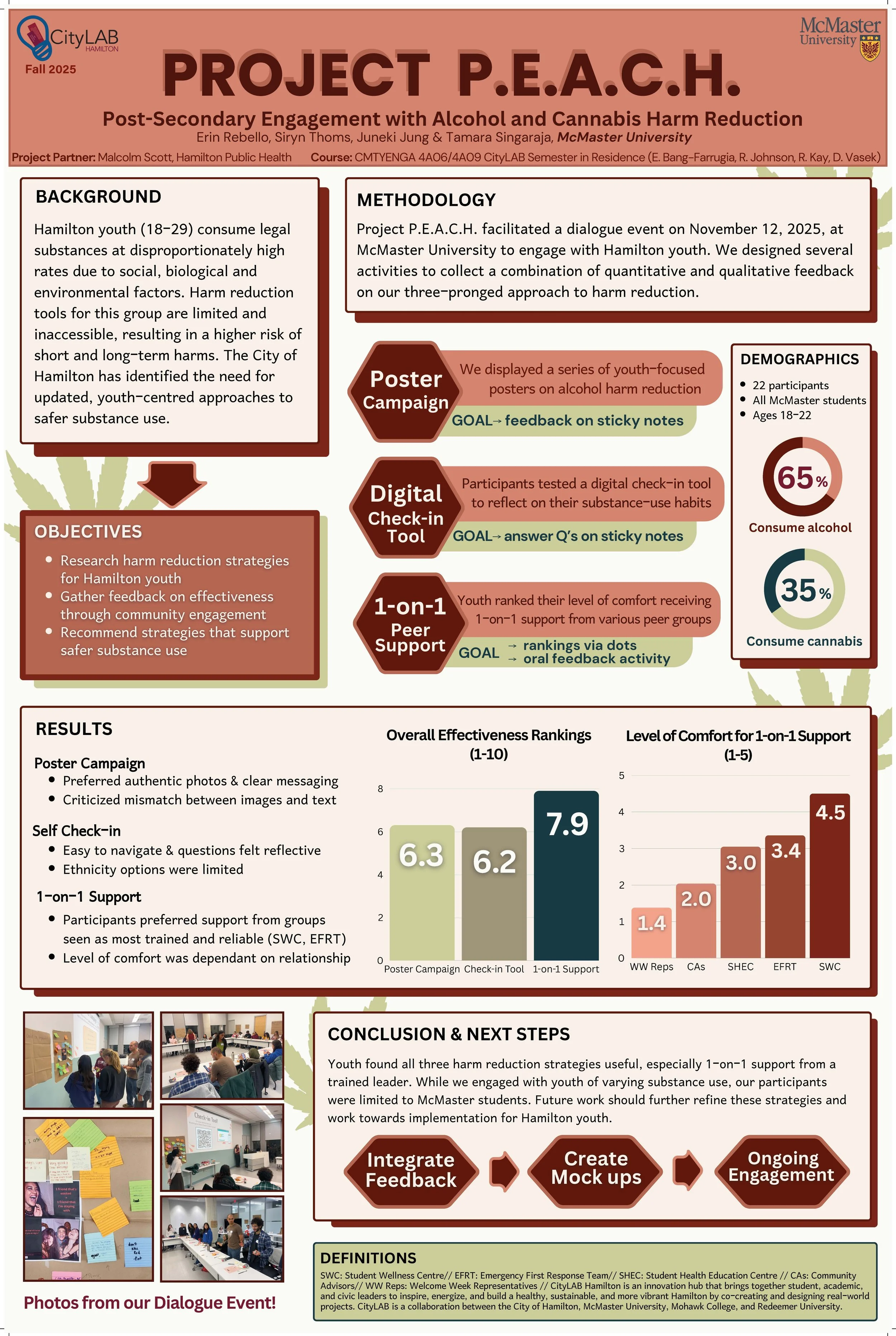
Promoting Healthier Attitudes towards Legal Substance Use

How can the City’s Public Health Services encourage healthier relationships with alcohol and cannabis among Hamilton post-secondary students??

Project Description: The City’s Public Health Services Division is interested in developing innovative health promotion programing to increase knowledge, change attitudes and beliefs, and promote healthier relationships with alcohol and cannabis among post-secondary students. This project will engage with post-secondary students since they are familiar with the matters that affect their lifestyles, what factors resonates with youth, and what should be considered towards potential solutions.

Through this project, students will review the literature on effective and innovative strategies that may encourage post-secondary students to develop healthier relationships with alcohol and cannabis, gather data from their fellow students to learn more about the local context and needs, and develop content which will help inform a communications strategy. Hamilton Public Health’s goal for the project results is to develop better alcohol- and cannabis-focused programming in the future that meet the needs of the City’s post-secondary communities.

City Staff: Malcolm Scott, Healthy and Safe Communities Department

Deliverables: Primary research, Secondary research, workshop/event

Project Partner: McMaster University, Semester in Residence

Location: City Wide

City Strategy Priority: Healthy and Safe Communities

Developing a Community Benefits Framework

What are existing actions being undertaken by the City of Hamilton that would fall under a Community Benefits Framework, and what more could be done if a Community Benefits Framework is adopted as a city-wide policy ?

Project Description: A Community Benefits Framework acts as a guide for Community Wealth Building which includes Community Employment Benefits, Social Procurement, and Community Benefit Agreements. The City of Hamilton and the Hamilton Community Benefits Network are undertaking this project challenge to understand how existing City initiatives can inform and support a Community Benefits Framework, and how this may assist the City as a strategic tool for community wealth building across municipal operations and resource requirements.

City Staff: Romas Keliacius, Healthy and Safe Communities Department

Deliverables: Primary research, Secondary research

Project Partner: McMaster University, Semester in Residence

Location: City Wide

City Strategy Priority: Healthy and Safe Communities, Community Engagement and Participation, Economic Prosperity and Growth, Built Environment and Infrastructure, Culture and Diversity

Giving to Build Up our Community

What are ways to encourage and enhance support for the City of Hamilton’s United Way fundraising initiatives?

Project Description: The City of Hamilton’s United Way Committee is looking for new and exciting ways to engage with new and existing staff to help boost the City’s fundraising initiatives for the United Way. This challenge involves reviewing ways to best to reach staff (both new and old) and encourage them to participate in City of Hamilton’s United Way fundraising initiatives. This may include, but is not limited to campaign strategies, literature review to determine most preferred modes of giving for younger audiences, generating ideas for promotional material, event recommendations, and developing content about the United Way as part of the City’s onboarding orientation for new City staff, etc.

City Staff: City of Hamilton United Way Fundraising Committee

Deliverables: Secondary research, marketing campaign

Project Partner: McMaster University

Location: City Wide

City Strategy Priority: Our People and Performance

CityHousing Hamilton Transportation Demand Management Study

What barriers do City Housing Hamilton tenants experience in accessing transportation programs whether in an urban setting or suburban setting?

Project Description: City Housing Hamilton (CHH) is trying to better understand how CHH tenants utilize available transportation, particularly two programs including Car-share and Bike-share which were implemented at City Housing Hamilton’s most recent developments. This project will undertake research on various issues which should be considered for the development of a transportation needs review for CHH. The research will assist the City to understand ways to support active transportation system design in new CHH developments.

City Staff: Kaywana Gargarello, City Housing Hamilton

Deliverables: Primary and secondary research

Project Partner: McMaster University

Location: City Wide

City Strategy Priority: Community Engagement and Participation