Economic Prosperity and Growth

3-D Prototyping for Community Initiatives

Can 3D printing be used to test viability and engage makers to produce and distribute essential tools for community needs?
Project Description: This hands-on project combines innovation, social impact, and community collaboration by engaging the student community in market research and prototyping innovative accessories and tools for individuals in need. As part of the first phase of the project, students will undertake research on the potential products which could be used for social need to develop from 5 to 10 viable products that can be produced using additive manufacturing. Future project phases will consider methods to partner with community organizations and determine optimal distribution channels to reach the target audience.

City Staff: Alex Consoli, Senior Program Manager, Corporate Services Department

Deliverables: Primary research, Secondary research, feasibility study, prototype/design, workshop/event

Project Partner: McMaster University

Location: City Wide

City Strategy Priority: Community Engagement and Participation, Healthy and Safe Communities, Economic Prosperity and Growth, Culture and Diversity


Integrating AI to assist in Development Planning Inquiries

How can Artificial Intelligence (AI) assist in Development Planning inquiries from the public and developers? Is there a business case to adopting AI?  What type of investment (time, staff, resources) are we looking at? Will it pay off?  

Project Description: AI is infiltrating all sectors including Municipal Planning.  Kelowna, BC and Burlington, ON are early adopters and the City would like assistance exploring the pros and cons.   Who is using it and what for?  Is it working and creating efficiencies?

In the Planning Dept we handle a great deal of inquiries from the public and developers about parcels of land and development potential.

City Staff: Tricia Collingwood, Manager, West Development Team and Business Facilitation, Planning and Economic Development

Deliverables: Primary research Report, Business Case, Prototype, Event/Workshop

Project Partner: Mohawk College

Location: City Wide

City Strategy Priority: Community Engagement and Participation, Economic Prosperity and Growth

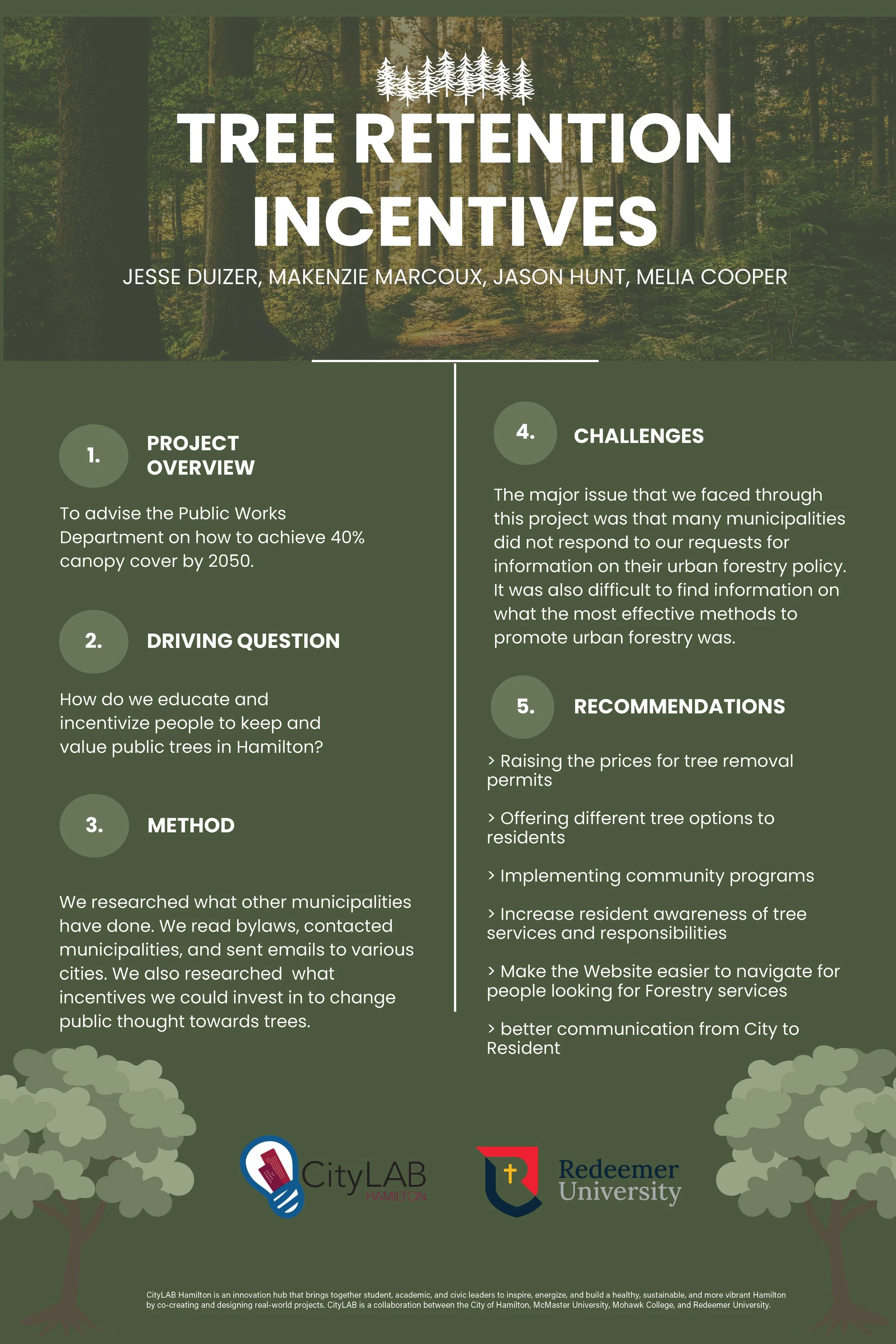
Public Tree Offsetting Fees

How can we encourage applicants to preserve and/or plant public trees that may be impacted through development?

Project Description: The City of Hamilton issues permits for any works that will affect a public tree in accordance with the City's Public Tree By-Law. The City wants to encourage applicants to preserve existing trees and to plant new trees. The focus of this project is to undertake a review of the practices used in other municipalities for offsetting fees (or “incentives”) for planting new trees, protecting existing trees based on development type. Key project tasks include reviewing and collecting information on what other municipalities are doing, conducting interviews with municipalities, and provide an analysis of the data collected.

City Staff: Louise Thomassin, Senior Project Manager, Public Works Department

Deliverables: Primary research, Secondary research, research report

Project Partner: Redeemer University

Location: City Wide

City Strategy Priority: Clean and Green, Economic Prosperity and Growth

Active Transport: Shifting Trends

What are the factors that may influence the adoption of active transportation modes?

Project Description: Over the years, the City has implemented numerous bike lanes and multi-use paths with the expectation of shifting trips from private vehicles to active transportation modes. This study will assess the actual versus expected impact on mode share and identify factors that may influence adoption. There are several research questions to be considered including:

  • What extent has the implementation of bike lanes and multi-use paths influence modal shift?

  • How does usage vary based on infrastructure type, land use, connectivity, and demographics?

  • What barriers limit higher adoption rates, e.g., safety concerns, network gaps, lack of end-of-trip facilities?

  • How do factors such as weather, trip distance, and social acceptance impact modal shift?

The information shall be used to help inform the framework for continuous performance monitoring of active transportation investments.

City Staff: Tanvir Chowdhury , Project Manager, Public Works Department

Deliverables: Primary research, Secondary research, feasibility study, policy paper

Project Partner: McMaster University

Location: City Wide

City Strategy Priority: Community Engagement and Participation, Healthy and Safe Communities, Economic Prosperity and Growth, Culture and Diversity, Clean and Green, Built Environment and Infrastructure

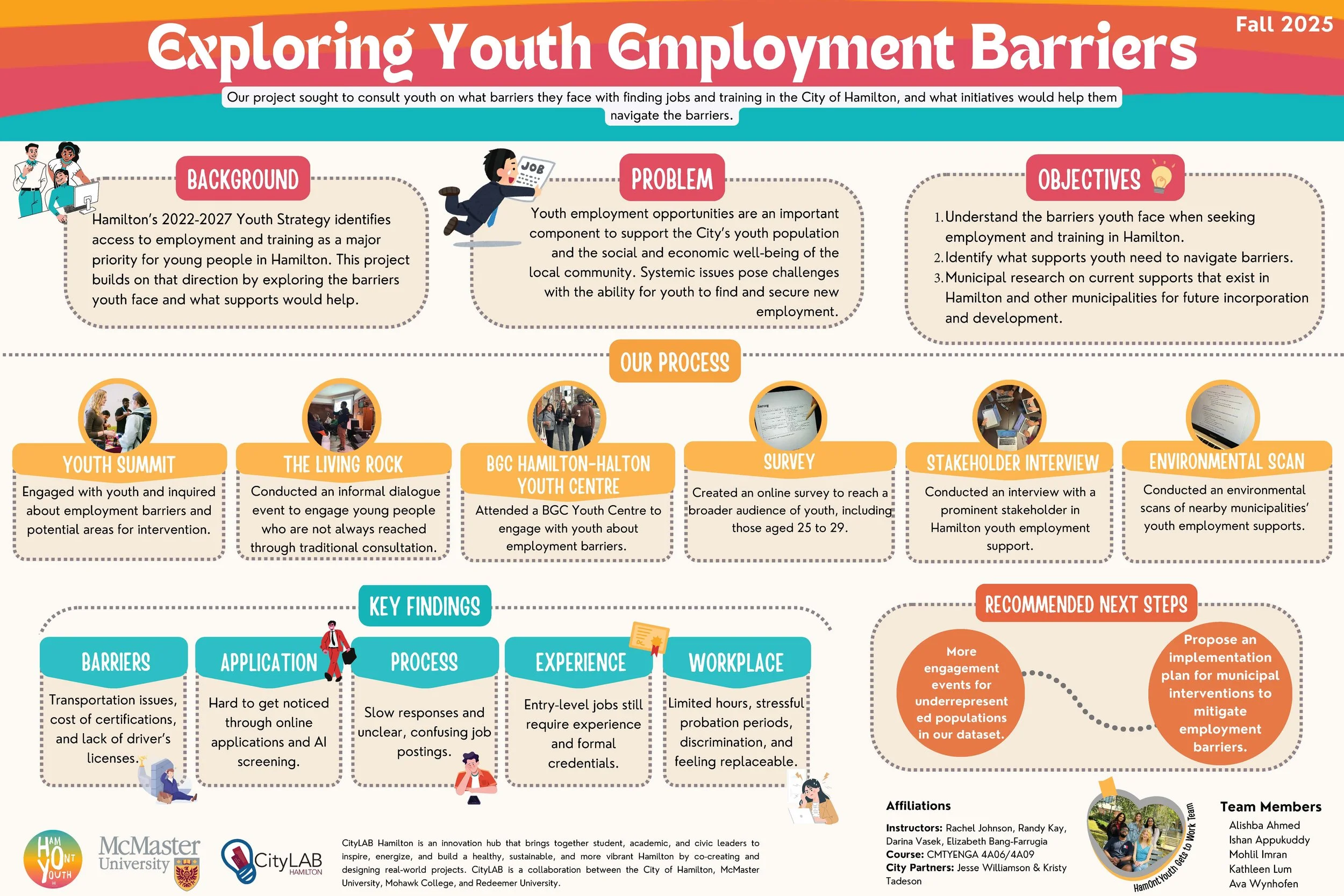
HamOntYouth Gets to Work

What are barriers and challenges for youth (ages 14 to 29) to access employment in Hamilton.

Project Description: Hamilton’s Youth Strategy, informed by youth residents, identified access to employment and training as a priority. With objectives to increase employment, improve wages, and access to financial supports, the City of Hamilton must first better understand the barriers and challenges faced by young people. This project will work along City staff and the HamOntYouth Steering Committee to answer key questions about the employment and training needs of Hamilton youth.

City Staff: Jesse Williamson, Healthy and Safe Communities Department

Deliverables: Primary research, Secondary research

Project Partner: McMaster University, Semester in Residence

Location: City Wide

City Strategy Priority: Community Engagement and Participation, Healthy and Safe Communities, Economic Prosperity and Growth

Municipal Grant Study

How can we measure the economic and social impact of programs and services funded by the City Enrichment Fund?

Project Description: The City Enrichment Fund (CEF) provides funding annually to support more than 300 nonprofit programs across Hamilton for service areas including Agriculture, Arts, Communities, Culture & Heritage, Community Services, Digital, Environment, and Sport & Active Lifestyles. The focus of this project is to quantify the economic and social impact of the programs supported by the City Enrichment Fund. The project will help develop insights including:

  • The economic impact of City Enrichment Fund program areas;

  • The estimated resource requirements for the municipality to provide these services directly;

  • The number of residents impacted by the programs which are funded through the City Enrichment Fund; 

  • A replicable methodology for assessing the City Enrichment Fund program areas.

Students shall review individual City Enrichment Fund projects as case studies to help create a methodology that shall calculate the replacement cost for future City Enrichment Fund projects.

City Staff: Rebecca Frerotte, City Manager’s Office

Deliverables: Secondary research, Business case

Project Partner: McMaster University

Location: Citywide

City Strategy Priority: Community Engagement and Participation, Economic Prosperity and Growth, Our People and Performance

Developing a Community Benefits Framework

What are existing actions being undertaken by the City of Hamilton that would fall under a Community Benefits Framework, and what more could be done if a Community Benefits Framework is adopted as a city-wide policy ?

Project Description: A Community Benefits Framework acts as a guide for Community Wealth Building which includes Community Employment Benefits, Social Procurement, and Community Benefit Agreements. The City of Hamilton and the Hamilton Community Benefits Network are undertaking this project challenge to understand how existing City initiatives can inform and support a Community Benefits Framework, and how this may assist the City as a strategic tool for community wealth building across municipal operations and resource requirements.

City Staff: Romas Keliacius, Healthy and Safe Communities Department

Deliverables: Primary research, Secondary research

Project Partner: McMaster University, Semester in Residence

Location: City Wide

City Strategy Priority: Healthy and Safe Communities, Community Engagement and Participation, Economic Prosperity and Growth, Built Environment and Infrastructure, Culture and Diversity

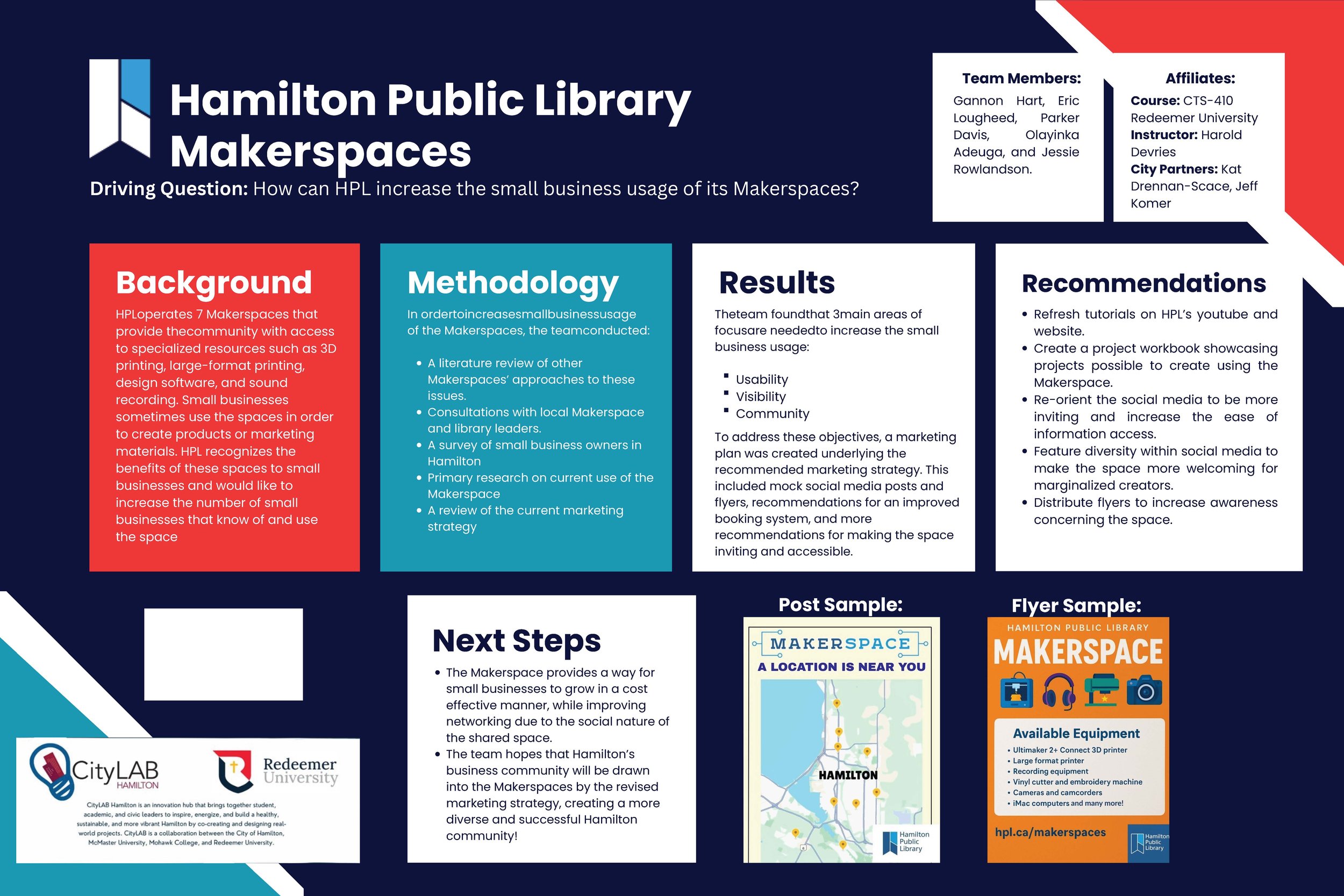
Makerspaces and Small Businesses

How can the Hamilton Public Library connect with small businesses so that they are aware of services that are available through the Library Makerspaces?

Project Description: There are seven Makerspaces located at Hamilton Public Library branches which offer a variety of services including large scale printing, sound recording, embroidery, and vinyl sticker printing. The Hamilton Public Library is interested in developing a strategy to connect with small business so that they know about what the Library Makerspaces have to offer.

City Staff: Kat Drennan-Scace, Hamilton Public Library

Deliverables: Marketing strategy

Project Partner: Redeemer University

Location: City Wide

City Strategy Priority: Community Engagement and Participation, Economic Prosperity and Growth